
Idaho VINE Coverage in Canyon
Idaho VINE is a free custody-information and notification service. Canyon County locally embeds a VINE status-update route in its jail roster and Current Arrests workflow. The Canyon County Prosecuting Attorney’s Victim Witness Program independently directs users to Idaho VINE and the statewide telephone line, 866-984-6343. IDOC also supplies state custody information to VINE.
Coverage remains tied to the reporting source. Canyon jail data describes a Canyon event. IDOC data describes state correctional custody. Neither source covers the Bureau of Prisons, Immigration and Customs Enforcement, or the U.S. Marshals Service. A person transferred out of Canyon can trigger a custody change while remaining confined elsewhere.
Search One Person on VINE
Start with an official identifier. Canyon Current Arrests can provide a County ID, arrest time, arresting agency, charges, and a per-record VINE link. The current roster can show continued inclusion but warns that it may include SILD, Pretrial Release, and ICS participants. Neither county page is a certified release record.
- Open Idaho VINE online or call 866-984-6343.
- Select Idaho and the custody or offender-search option.
- Enter the full name. Add the booking, County, or offender ID when the interface accepts it.
- Compare all available identifiers among matches. Check middle name, age or birth year, ID, agency, and location.
- Open the correct record and read the custody status, location, source agency, and event description.
- Preserve the source and event time before checking the originating agency.
Aliases, suffixes, hyphenation, spelling changes, and source delays can cause a miss. A common-name match should never be joined to a charge, mugshot, or release event without supporting identifiers. When identity remains unresolved, request the custodian’s record.
The official Idaho VINE search shows the state-specific entry point.
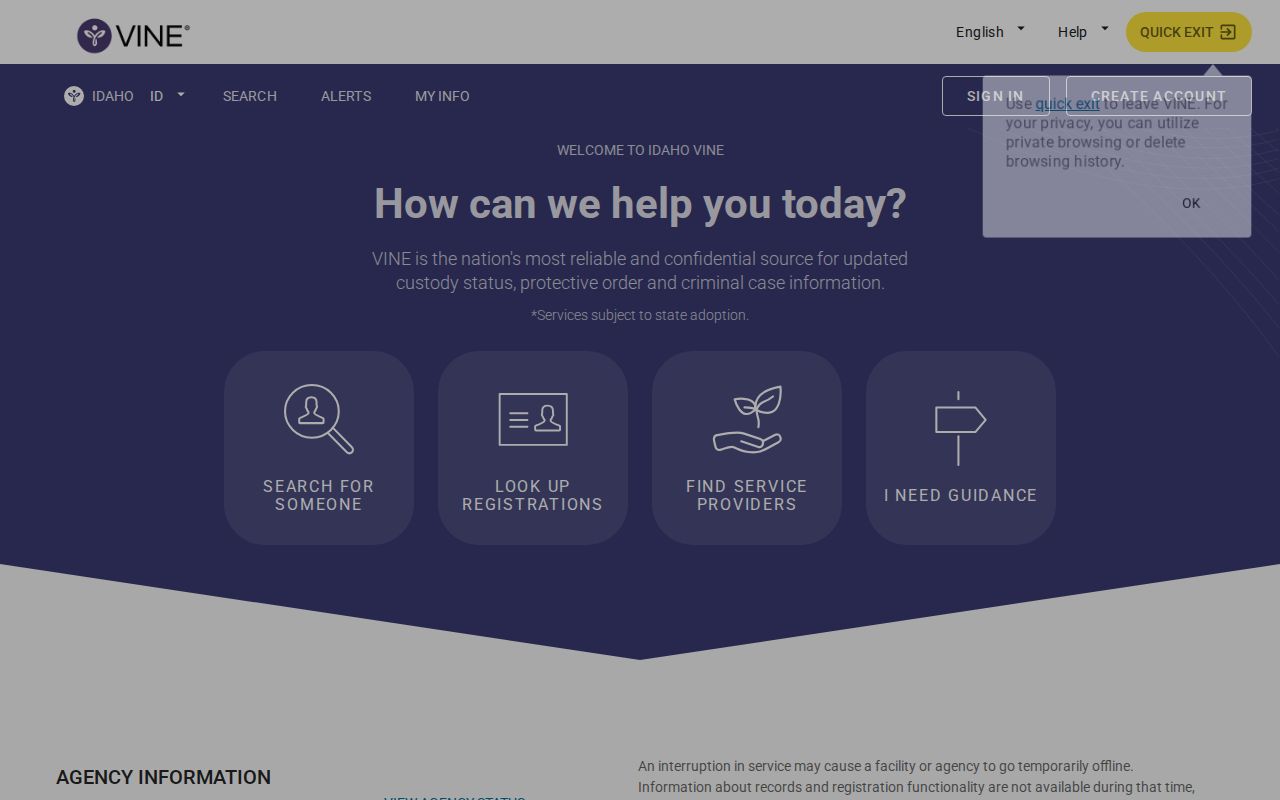
The search view is a locator and notification gateway. It is not a permanent Canyon release-log archive.
Read the VINE Result Carefully
Available fields vary with the source record, so no single field set should be promised. Focus on the identifiers and event that are actually displayed. Preserve wording exactly when the service distinguishes release, transfer, escape, or another custody change.
| Field | What it can establish | Limit |
|---|---|---|
| Name and identifier | Helps select the intended person | Name alone is not enough |
| Custody status | Reports the source agency’s current event or state | May lag and may not describe another custodian |
| Facility or location | Identifies the reporting placement | A transfer can change it without community freedom |
| Event date/time | Dates the VINE source event or notification | May differ from the signed release-form time |
| Release or custody change | Signals that the reporting agency recorded movement | Does not certify unrestricted release |
| Notification options | Allows alerts for selected events | Availability can vary by source |
A released or custody-change result can describe transfer to IDOC, ICE, another county, or another authority. Ask Canyon Sheriff Records for the receiving-authority field when the destination matters. For state data, open the IDOC detail and distinguish In custody, In community, Discharged, and Active Bench Warrant.
Register a Canyon Release Alert
Registration begins from the correctly matched record. Do not subscribe from a weak name-only match. Choose the event and channel offered for that source.
- Open the matching person record.
- Select notifications and the relevant release or custody-change event.
- Choose phone, text, email, app, or an available combination.
- Enter and confirm the destination information.
- For telephone alerts, create a four-digit PIN.
- When the automated call arrives, enter the PIN to acknowledge it.
- Save the source agency and contact information for follow-up confirmation.
IDOC states that an unacknowledged phone notification repeats every two hours for 48 hours. The PIN confirms receipt of the automated call; it does not authenticate a release record. For general VINE or PIN help call 866-984-6343. IDOC-specific assistance is available at 208-605-4774.
The IDOC Victim Services guidance documents the state notification process.

Keep contact destinations current. A disconnected telephone or filtered email can prevent a useful notification from reaching the registrant.
Canyon Links Booking Cards to VINE
Canyon’s local workflow is distinctive because Current Arrests pairs an official booking card with a route for VINE status updates. The card can show a photograph, County ID, arrest date and time, agency, and charges. It does not show a release field. The VINE route helps bridge that booking to a later alert, but the two tools still serve different purposes.
The Canyon Victim Witness Program also points to Idaho VINE and the same 866-984-6343 line.
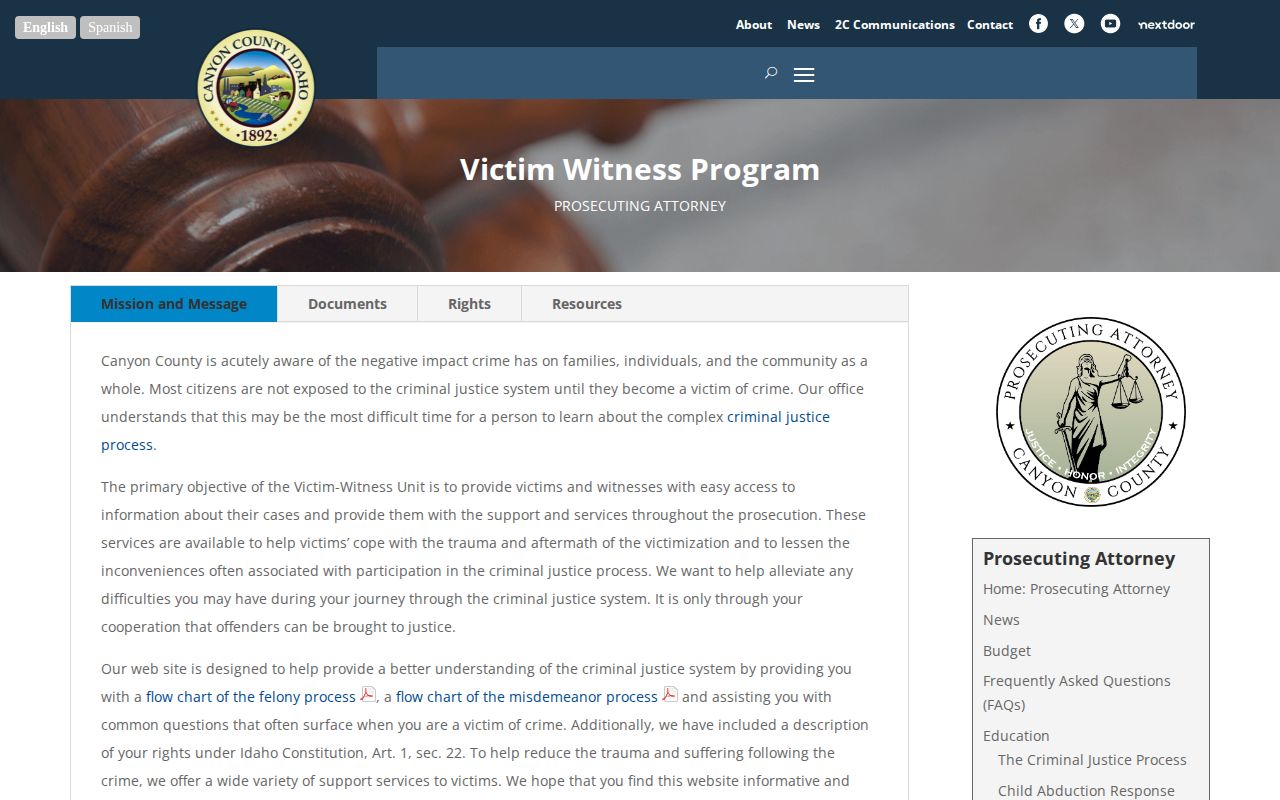
This local layer confirms Canyon participation, not guaranteed real-time accuracy. Source-feed lag and interagency movement still require agency confirmation.
Confirm Every Reported Release
After a Canyon alert, call the detention status line at 208-454-7541 and request the release form or release-log entry when documentary proof matters. The Sheriff record should identify release time, date, authority, receiving authority, and deputy signature. A receiving authority is the clearest way to distinguish community release from transfer.
For an IDOC event, open the Resident/Client Search. In community / Parole with Released to Supervision supports a physical prison-to-supervision transition. In community / Probation may reflect a court sentence without prison release. Discharged indicates that IDOC jurisdiction ended. Contact District 3 when the current officer, transfer, or status is important.
Use iCourt for the judicial context, such as a bond order, dismissal, or sentence. A docket does not record the exact jail-door time. A certified court order proves the order, while the release form proves the physical custody event.
VINE Boundaries and No-Match Results
VINE does not replace the BOP locator for federal prison custody or the ICE Online Detainee Locator System for immigration custody and its limited recent-release view. USMS has no comparable public released-person locator. A federal defendant can leave a local jail through court release or transfer without ever appearing in BOP’s prison database.
A no-match VINE result is inconclusive. Spelling, timing, suppressed information, source boundaries, and movement can all explain it. Search the correct source system, try the official identifier, and contact the custodian. Do not turn silence into proof that a person was never held or has been released.
VINE is not a certified historical record. A locator screenshot can document what was displayed on a date, but a signed release form, movement record, or discharge certificate provides stronger evidence. Transfer chains require both the releasing and receiving side.
Coverage, contacts, and displayed fields were reviewed July 16, 2026. Recheck the official Canyon, IDOC, and VINE pages because live systems can change.
Resolve Conflicting Custody Signals
Different systems can appear to disagree because each reports only its own custody. If VINE sends a Canyon release notice while IDOC shows In custody, the likely sequence is a county-to-state transfer. If ICE later lists a released date, Canyon release and ICE release are two separate endpoints. Record the reporting agency and time for each event, then confirm both sides of the movement.
A person can remain on Canyon’s roster while someone reports seeing that person outside. The roster warns that SILD, Pretrial Release, and ICS placements can be included. Those programs permit authorized activity outside jail walls while the participant remains under court or Sheriff control. A VINE event or visual sighting should not be relabeled discharge. The court order and Sheriff release form settle different parts of the question.
When iCourt shows a dismissal but VINE or a locator still reports custody, compare every case and hold. One dismissed charge does not cancel a second case, warrant, probation matter, civil contempt placement, detainer, or receiving-agency request. The docket explains judicial action; it is not the live custody ledger.
Time labels also need discipline. An arrest time, VINE event, release-form signature, court filing, and nightly locator update may cross midnight. Preserve each source’s date and timezone context rather than merging them into a single unsupported timestamp. The signed Canyon release form remains the preferred record for the county event’s actual date and time.
For a transfer, request the receiving-authority field and follow the record into the named system. IDOC, another county jail, ICE, or a federal authority may begin custody as Canyon ends it. Confirming both custodians avoids the false conclusion that a VINE release alert always means return to the community. For an older event, use the agency record rather than expecting VINE to function as a permanent archive. Save the County ID, source agency, event wording, and time before a live page changes.