
Parole and Probation Compared
Parole is conditional release during the indeterminate portion of an Idaho felony sentence. The Idaho Commission of Pardons and Parole decides whether to grant it, and IDOC supervises the person after the physical transition. A Parole Eligibility Date is only the earliest point at which release may be considered. It is not a promise that release will occur.
Probation is a court sentence. An IDOC record marked In community / Probation may describe someone who never entered state prison. Felony probation is generally supervised by IDOC. Canyon County Misdemeanor Probation separately handles local misdemeanor cases from 1115 E. Chicago Street, Caldwell, at 208-454-7344.
| Question | Parole | Probation |
|---|---|---|
| Who authorizes it? | Idaho Commission of Pardons and Parole after prison eligibility | The sentencing court |
| What does it follow? | Physical IDOC confinement or a reentry placement | A community sentence, suspended term, or withheld judgment |
| Best public clue | In community, sentence row marked Parole, with Released to Supervision | In community with a sentence row marked Probation |
| Who supervises? | IDOC Probation and Parole | IDOC for qualifying felony matters; Canyon County for local misdemeanors |
| When does it end? | Discharge or Sentence Satisfaction, if no later change occurs | Court or agency discharge at the end of jurisdiction |
Check an IDOC Supervision Record
The IDOC Resident/Client Search accepts a last name with an optional first name, or an IDOC number. Use identifiers from a booking card or court case whenever possible. A common-name match should not be attached to a charge, image, or release date without corroboration.
- Search by IDOC number when available. Otherwise enter at least two letters of the last name and narrow with the first name.
- Compare the IDOC number, middle name, birth year, and sentencing county among the results.
- Open the detail. Do not rely on the result-page label alone.
- Inspect each sentence row for Parole or Probation. Record Released to Supervision separately from Sentence Satisfaction Date.
- Note the supervising district, officer, and telephone information shown on the current detail.
- If the record is unclear or current contact matters, call IDOC District 3 rather than inferring status from a stale screenshot.
A sentence row marked Parole with a Released to Supervision date documents the prison-to-community transition. A probation row does not prove a prison release. Active Bench Warrant is also materially different from ordinary community supervision and calls for official confirmation.
The official in-community detail example shows why opening the record matters.
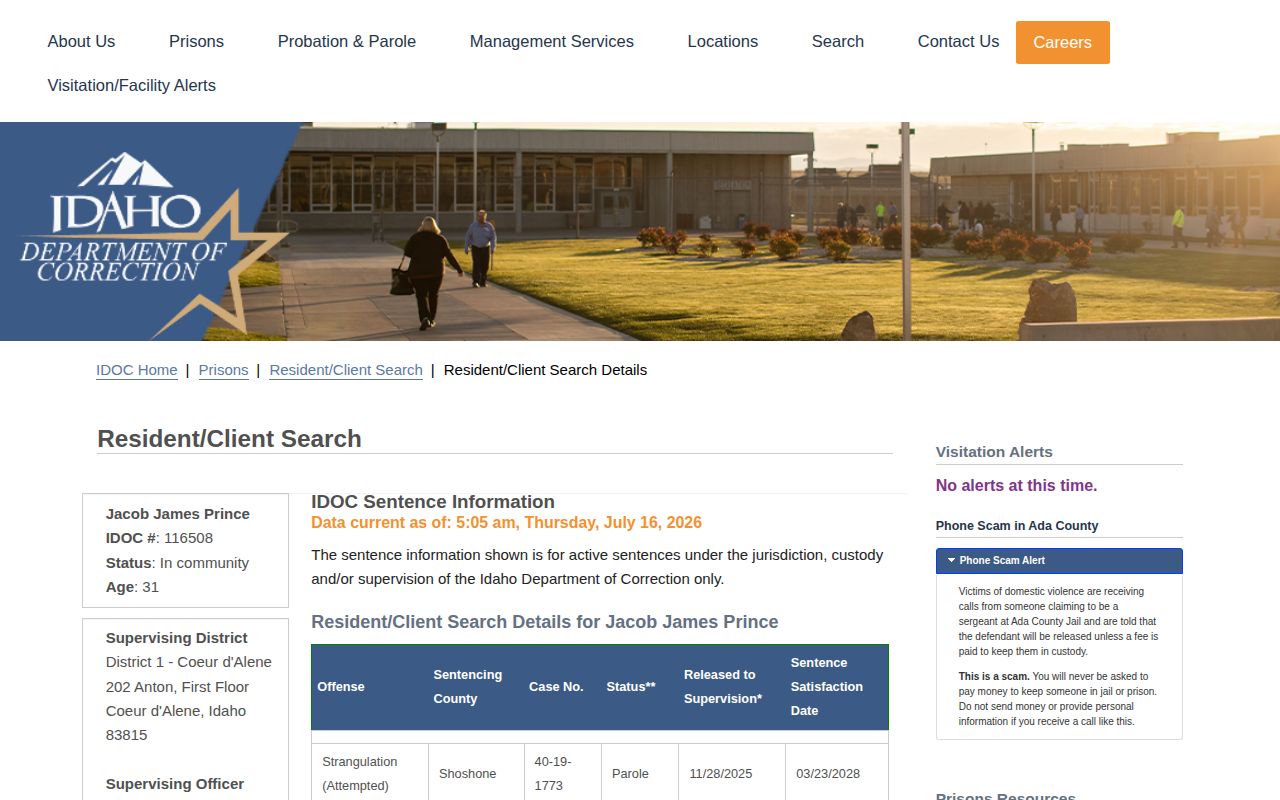
Those fields should be preserved as separate facts. Combining them into one “release date” can turn a projected end of jurisdiction into a false physical-release date.
District 3 Serves Canyon County
Canyon County belongs to IDOC Probation and Parole District 3. Its main office is at 3110 Cleveland Boulevard, Building D, Caldwell, ID 83605, telephone 208-454-7601. The annex is at 3122 Cleveland Boulevard, Building E. IDOC also lists a Middleton satellite at 109 S. 3rd Avenue. Check the current IDOC page before traveling because assignments and public counter arrangements can change.
IDOC District 3
3110 Cleveland
Boulevard, Building D
Caldwell, ID 83605
208-454-7601
Canyon County Misdemeanor Probation
1115
E. Chicago Street
Caldwell, ID 83605
208-454-7344
The IDOC detail may name a particular officer and district. That current record is more useful than assuming a Canyon conviction always remains assigned in Caldwell. Supervision can transfer, and public contact details can change.
Hearings Are Sequential Milestones
The Commission publishes a live hearing schedule with date, time, hearing type, IDOC number, and name. As of April 3, 2026, schedules were posted weekly, with the daily order appearing after the prior session closed. Dates can change. Incarcerated participants attend virtually; current public-attendance and testimony rules should be checked with the Commission.
The decision page publishes Notices of Action Taken, generally by the end of Friday following an individual hearing. Outcomes include grants, denials, deferrals, rescissions, revocations, reinstatement, additional time, new tentative dates, and passing to full term. Preserve the notice’s exact wording.
- The schedule shows that a hearing is planned.
- The Notice of Action records what the Commission decided.
- A tentative parole date describes a conditional plan.
- IDOC’s later In community / Parole status and Released to Supervision date document the physical transition.
- A later Discharged status indicates the end of IDOC jurisdiction.
Programs, an investigated and approved parole plan, signed paperwork, and transportation may remain after a grant. Idaho Code §§19-2513 and 20-223 make eligibility and Commission authority distinct from actual release.
Violations, Warrants, and Absconders
Supervision can change after release. A violation may lead to a warrant, arrest, revocation hearing, reinstatement, additional prison time, or return to parole after a period. IDOC’s Fugitive Recovery listings are limited to wanted subjects. They are not a directory of everyone released in Canyon County and should never be treated as a general photo gallery.
An Active Bench Warrant or absconder entry calls for the exact agency status, not a guess about the person’s location. Idaho VINE may provide a custody-change notice, but it does not certify supervision compliance. Use the VINE Inmate Check for notification and confirm the underlying event with IDOC District 3 or the custodian holding the person.
Nampa Reentry Is Still Placement
The Nampa Community Reentry Center gives Canyon County a local residential transition path that is separate from county jail release. NCRC is an IDOC facility at 1640 11th Avenue North, Nampa, telephone 208-465-8490. A resident may be approaching parole or discharge but remains in state correctional placement until the IDOC record changes.
Use the Nampa Community Reentry Center guide and IDOC detail together. “In custody” or a CRC location is not community discharge. “In community / Parole” with Released to Supervision documents the later transition. District 3 also publishes reentry tools for purpose-neutral transportation and service navigation; those resources do not alter custody status.
The Signed Release Form Matters
Idaho Jail Standards require a county-jail release form to state the time, date, authority for release, receiving authority, and releasing deputy’s signature. They also require a signed receipt for returned property. These records can distinguish release to the community from transfer to IDOC, another county, ICE, or another authority.
Canyon adds a local commissary detail: if an order arrives after release, the credited amount becomes a prepaid card available through the detention-center visitation area. That property process is not proof of parole, yet it can support the chronology of an actual county release. Request the release form or log from Sheriff Records at 1115 Albany Street, Room 137, Caldwell, by the official records form, email ccsorecords@canyoncounty.id.gov, or telephone 208-454-7488.
A narrow request should identify the name, County ID if known, and date range, and ask for release date/time, release authority, receiving authority, booking sheet, and signed property receipt. The state public-record response clock and lawful exemptions still apply. Medical or protected safety details may be redacted.
When Supervision Ends
Sentence Satisfaction Date is the calculated full-term endpoint and may change. It is not automatically the day someone left prison. IDOC’s Discharged label is stronger public evidence that jurisdiction ended, while a Gold Seal discharge notification is formal completed-sentence evidence. The Commission says a Gold Seal proceeds through the last supervision district and may take up to a month.
Court records can explain a probation discharge or later order, but they do not supply the exact moment a jail or prison relinquished physical custody. Use iCourt Smart Search to identify the case and request the entered order from the clerk when needed. The evidence chain is status clue, agency movement or release record, court authority, and receiving-agency confirmation when a transfer occurred.
Source and contact details on this page were reviewed July 16, 2026. Live statuses, office assignments, and Commission schedules can change, so important findings should be checked with the originating agency.
Separate County and State Supervision
A Canyon conviction does not by itself identify the supervising office. The IDOC detail should be checked first for a felony parole or probation row and its assigned district. A local misdemeanor case belongs with Canyon County Misdemeanor Probation instead. When records show more than one sentence, verify each row and case number because state supervision in one matter can overlap a county obligation in another. The supervising office can confirm its own assignment, but it cannot rewrite the court judgment or certify a Sheriff release event.