
Define the Canyon Release Window
A three-day request should use exact calendar endpoints rather than “the last 72 hours” alone. State the beginning date and time, ending date and time, and local time zone. Include the person’s full name, date of birth, County ID, and booking date when known. If the goal is to find every release event in the interval rather than one person, ask the custodian whether a date-bounded release log exists and request only the core public fields. A focused range reduces unrelated material and redaction work.
Canyon publishes no retention promise for Current Arrests or a recent-release archive. The fact that several booking days were visible during the research inspection does not define how long a card will remain. Save the County ID and booking details while they are available, but rely on the agency record for a durable result. Under Idaho public-records law, the response clock concerns the agency’s grant, denial, or extension notice. It does not convert an online booking stream into an archive.
Identity checks remain essential across a weekend. In iCourt, use a full case number or the party format LAST, FIRST, then compare middle name, suffix, birth year, and location. Court entries during the window can show a bond order, dismissal, time-served judgment, or sentence. The jail release form still provides the actual custody-end time. If another agency received the person, follow that receiving authority through its own locator or records office. That transfer may fall inside Canyon’s three-day log even though no community release occurred.
Canyon 72-Hour Feed Status
Canyon County does not publish a verified 72-hour release list as of July 16, 2026. Sheriff navigation, the live roster, Current Arrests, and searches of the official county domain did not reveal a released-person tab or a rolling three-day archive. The absence is dated because a later redesign could add one. Current Sheriff navigation should be checked again for future use.
The live jail roster identifies people included in the current system. The separate Current Arrests stream identifies recent bookings. Neither offers a release date, time, reason, receiving agency, three-day filter, stated update cadence, or declared retention period. Visible booking dates cannot be subtracted from today to create a Canyon County 72-hour release feed.
Build a Canyon Three-Day Check
A wider inquiry needs a defined start and end time. Use calendar dates and include the year. If the period crosses a weekend or holiday, say so in the records request. Keep full name, date of birth, County ID, and booking date at hand. Search tools can narrow the match, but the requested log supplies event proof.
- Check Current Arrests for the booking identity, County ID, arrest date and time, agency, and linked VINE route.
- Compare the current roster. Presence is not always physical confinement because Canyon lists some alternative programs.
- Search the person on Idaho VINE or call 866-984-6343 for the source-reported custody status.
- Call 208-454-7541 when the event is recent or the two county tools conflict.
- Search iCourt for a bond, dismissal, sentence, or other order during the period.
- Request the Sheriff release log for the exact three-day range, including release and receiving-authority fields.
Use the 24-Hour Releases route for a same-day event. A state-prison movement requires the IDOC Resident/Client Search instead; a county-jail release and state discharge are different records.
Canyon Three-Day Record Fields
Because there is no online 72-hour list, the release form and date-bounded log define the fields that matter. Idaho Jail Standards require positive identification, verified authority, checks for holds and warrants, and a record of the receiving authority when another agency takes custody.
| Requested field | Why it matters across 72 hours |
|---|---|
| Full name and County ID | Connects the event to the correct booking. |
| Release date and time | Places the event inside the requested three-day window. |
| Authority or reason | Identifies bond, court order, time served, sentence completion, or another basis. |
| Receiving authority | Distinguishes community departure from a transfer. |
| Releasing deputy signature | Documents the staff verification and completed event. |
| Property receipt | Supports the final release process for property returned. |
A public copy can redact protected medical, behavioral, privacy, or safety information. Ask for the core release fields rather than a broad jail file. A focused scope helps the records unit locate the right material without treating an arrest history as the requested release log.
Canyon Weekend Release Gaps
A 72-hour span can capture a Friday-to-Monday sequence that a same-day check misses. It does not remove source lag. Canyon County publishes no guaranteed release hour, no weekend publication schedule, and no online archive behavior for releases. Court activity and office availability can also fall on different days from the actual jail event. The date on a bond or dismissal order explains authority; the jail form supplies the custody-end time.
Transfers complicate the window further. Overcrowding can place a person in another county facility. A hold can send that person to IDOC, ICE, or another authority. In each case, Canyon custody may end within the three-day range while confinement continues elsewhere. Follow the receiving authority named in the record rather than reporting the transfer as unrestricted release.
Note: A release request should name both calendar endpoints and ask whether each entry was a community release or an agency transfer.
Canyon Roster Release Quirks
Canyon splits “currently housed” roster data from a Current Arrests stream that says people “are/were housed.” That wording is easy to overread. Current Arrests supplies a photo, County ID, arrest time, arresting agency, charges, and VINE link, but no explicit released or current flag. The roster supplies current inclusion but warns that SILD, Pretrial Release, and ICS participants may be listed.
Thus, roster presence does not always mean a person is inside a jail building. Absence does not prove community freedom. A person seen outside may be in a conditional program, while a missing name may reflect a transfer. This local structure is why Canyon County’s official release form and receiving-authority field carry more weight than a visual comparison of two web screens.
The Current Arrests source illustrates the booking-side fields used to identify a record.
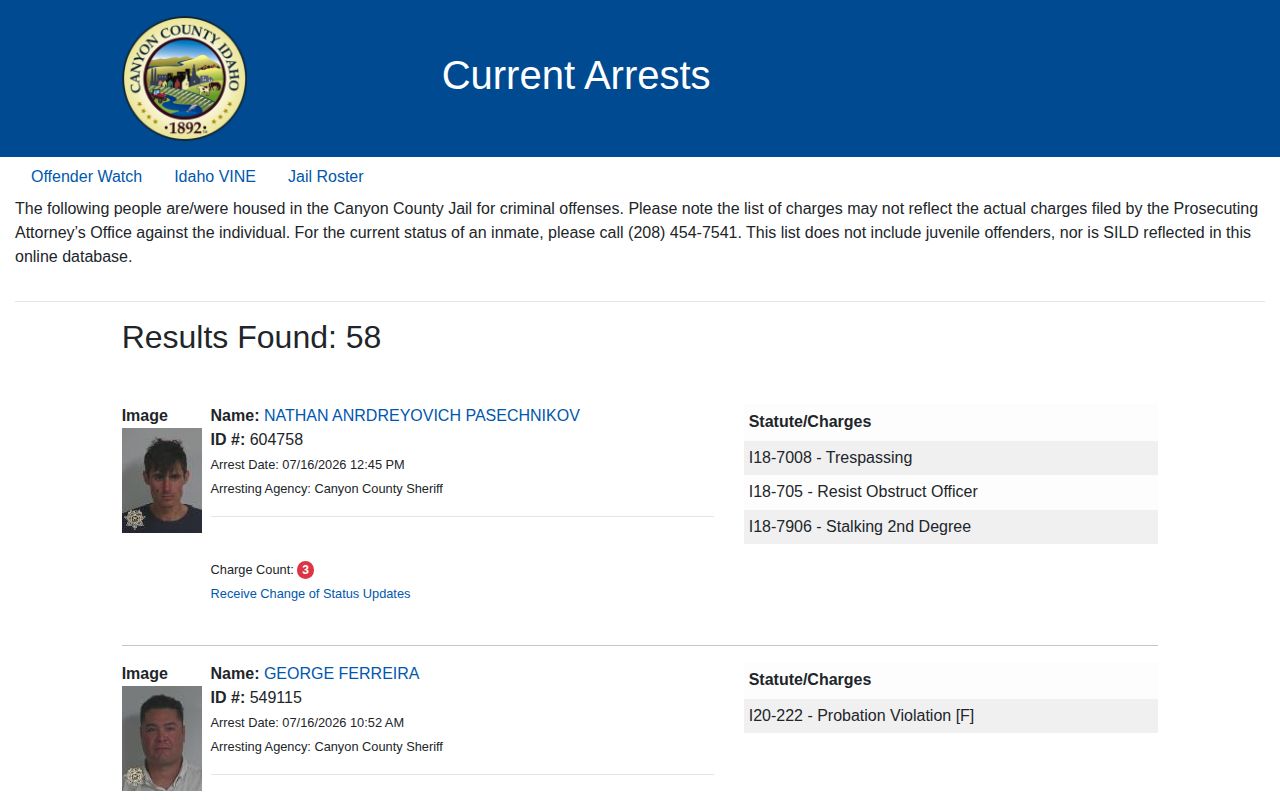
The pictured interface should be captioned and understood as recent arrests and booking photos, not releases. Its VINE route can support the next check.
Request Canyon 72-Hour Logs
Submit the Sheriff records request with a precise range. Useful wording is: “Release form or release log for [name and County ID or date of birth], from [start date and time] through [end date and time], showing release date, time, authority or reason, and receiving authority.” Add the most recent booking sheet or property receipt only when it serves the inquiry.
Canyon County Sheriff Records is at 1115 Albany Street, Room 137, Caldwell, ID 83605. Contact 208-454-7488 or ccsorecords@canyoncounty.id.gov. Weekday phone and email service runs from 8 a.m. to 5 p.m.; walk-ins end at 4:30 p.m. No flat Sheriff booking-photo fee is published.
Idaho Code §74-103 governs response timing for public-record requests. For Idaho residents, the agency generally acts within three working days or gives written notice that more time is needed, with an extended response completed within ten working days. Under §74-102, actual labor, copying, and redaction costs may apply beyond resident allowances. Ask for an itemized estimate if the three-day log becomes broad.
Canyon Custody Across Three Days
If the person moved to IDOC, open the state detail and distinguish In custody, In community, and Discharged. An In community row may document parole or probation and a Released to Supervision date. It does not mean all state jurisdiction ended. If another county or ICE received the person, use that receiving system. VINE can bridge the change, but an alert is not the date-bounded official log. The useful chain is Canyon booking identity, source-reported movement, release authority, and the record of where custody went next.
Holiday timing can stretch a records response without changing the release date. Do not shift an event into the next business day merely because the records counter was closed. Ask for the recorded jail time and date. When a court order and jail form carry different timestamps, preserve both. The order supplies legal authority, while the form documents operational release. No Canyon Sheriff mobile release app was verified.
Public Record Search
Sponsored Results