
Projected and Actual Dates Differ
A projected, tentative, or calculated date describes what may happen if the sentence and underlying facts remain unchanged. An actual release record describes when an agency relinquished custody. Canyon’s current roster carries no release-date field. IDOC uses several precise fields rather than a generic projected-release label.
A pretrial detainee usually has no sentence-based release date. Departure can turn on bond, an own-recognizance order, dismissal, another court order, a hold, or transfer. Search the case in iCourt, call Canyon jail status at 208-454-7541, and request the Sheriff release form. Do not calculate a date from the arrest or charge.
Use Idaho’s Exact Date Fields
The IDOC Resident/Client Search allows a name or IDOC-number search. Open the person’s detail and preserve the field label. A displayed date should never be renamed “release date” merely because it is the only date visible.
| IDOC or Commission field | What it means |
|---|---|
| Sentence Satisfaction Date | The calculated full-term end of the sentence. It is not necessarily the day of physical prison departure. |
| Parole Eligibility Date (PED) | The earliest point at which parole may be considered, commonly when the indeterminate portion begins. |
| Next Parole Hearing Date | A scheduling field for Commission review, not an approved release. |
| Tentative Parole Date | A conditional target after Commission action. Programs, plan approval, paperwork, and transportation may remain. |
| Released to Supervision | The date most recently placed on a supervision period by a court or the Commission. |
| In community / Parole | Public status supporting a physical prison-to-community transition under parole supervision. |
| Discharged | The strongest public locator label that IDOC jurisdiction ended on the stated date. |
The official IDOC detail example illustrates Sentence Satisfaction and Parole Eligibility fields.
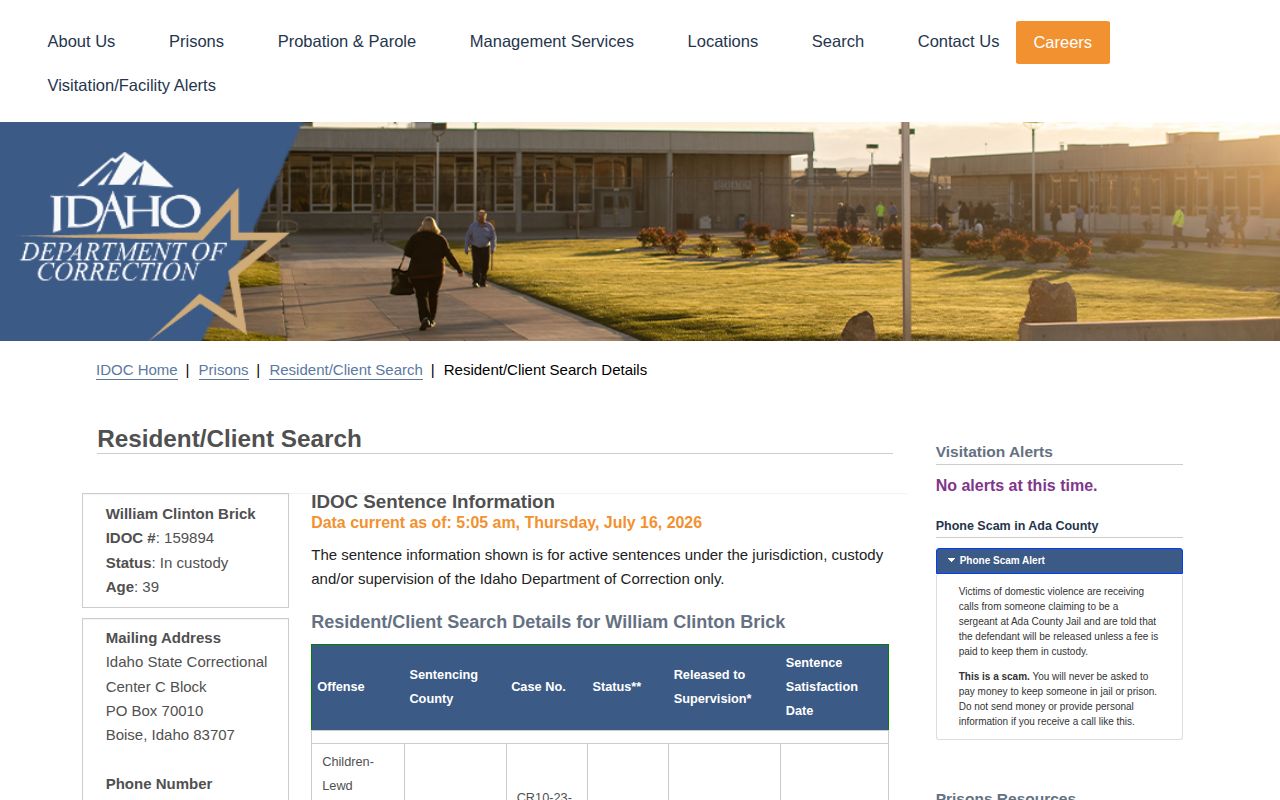
Read all sentence rows. Multiple cases and consecutive terms can make one isolated date misleading.
Find the Correct Canyon Date
- Classify the custody: Canyon pretrial jail, sentenced county jail, IDOC prison or reentry placement, federal prison, immigration custody, or another receiving county.
- For Canyon jail, check the roster only for current inclusion and Current Arrests only for booking data. Neither publishes a release window or release date.
- Open iCourt for the judgment, sentence, bond order, dismissal, or later case event.
- For a sentenced county term, ask the Sheriff or court for the sentence calculation and any §20-621 commutation actually applied.
- For state custody, search IDOC by IDOC number or verified name and open the complete detail.
- For parole planning, compare the Commission decision with later IDOC status.
- Confirm actual Canyon release with the signed release form or log, including release authority and receiving authority.
The Sheriff records form is available through the official Canyon records-request page. A narrow request can ask for the release date and time, release authority, receiving authority, sentence calculation, and signed property receipt for a named person and approximate booking range.
For IDOC records beyond the locator, use its GovQA portal to request an existing sentence-calculation or movement/release-to-supervision record. Ask for the field already maintained by the agency; do not demand that staff create a new projected date.
Modern Idaho Has No General 85% Rule
Idaho Code §19-2513 creates a unified sentence. The court imposes a fixed or determinate minimum and may add an indeterminate term. During the modern fixed term, there is no parole, discharge, or routine good-conduct reduction except extraordinary meritorious service under §20-101D and medical parole. Consecutive fixed terms run before the indeterminate portions.
That structure means no general “serve 85 percent” rule applies. A modern state prisoner generally serves the fixed portion. Parole after eligibility remains discretionary. Converting the sentence into an 85 percent estimate would contradict Idaho’s actual framework and can produce a false date.
Formula good time under §20-101A concerns offenses committed before July 1, 1986. It cannot be generalized to a current case. For newer offenses, §20-101D permits the IDOC director to award a reduction for extraordinary heroism or outstanding service, such as saving life, preventing major destruction during a riot, or preventing escape. The maximum described by the statute is 15 days per sentenced month, and an award may be withdrawn. It is not routine credit for ordinary good behavior.
County Jail Credit Uses Another Rule
A sentenced Canyon county-jail prisoner falls under a different statute. Idaho Code §20-621 provides five days off each month for a person with a good record who performs assigned tasks orderly and peaceably, upon Sheriff recommendation through the magistrate. The Idaho Supreme Court’s decision in State v. Thiel held that a magistrate lacks discretion to reject the Sheriff’s qualifying recommendation.
This county rule applies to a sentenced county-jail term. It is not a formula for pretrial detention and does not reduce a modern IDOC fixed term. Ask for the actual recommendation and calculation rather than assuming every month automatically received credit.
| County sentenced-jail calculation | Modern IDOC unified sentence |
|---|---|
| Court judgment establishes the county term. | Court judgment sets fixed and any indeterminate portions under §19-2513. |
| §20-621 may provide five days per month after a qualifying Sheriff recommendation. | No routine good-time reduction of the fixed term. |
| Sheriff/court calculation is the proper source. | IDOC detail and calculation record are the proper sources. |
| Actual release can still be affected by another hold or transfer. | PED only opens discretionary parole review; it does not guarantee release. |
No general Idaho statute was located requiring Canyon to release a county prisoner early on Friday when a term ends on a weekend or holiday. Section 20-223 has a preceding-weekday provision specifically for a parole eligibility date on a Saturday, Sunday, or legal holiday. It still depends on a Commission grant and final approval and should not be applied to an ordinary county sentence.
Why a Date Can Move
A release-related date can change because the inputs or legal posture change. Record the source and review date rather than treating a screenshot as permanent.
| Factor | Effect on the record |
|---|---|
| New or corrected court order | Changes sentence terms, credit, concurrency, or the authority for release. |
| Consecutive cases | Requires fixed terms and multiple sentence rows to be reconciled. |
| County credit recommendation | Can alter a sentenced-jail calculation when §20-621 is satisfied. |
| Extraordinary meritorious award | May reduce a modern IDOC sentence under the narrow §20-101D standard. |
| Parole denial or deferral | Leaves the person confined beyond the earliest eligibility point. |
| Programs or failed parole plan | Can prevent a tentative date from becoming an actual release. |
| Warrant, absconding interval, or violation | Can add custody time or change supervision status. |
| Detainer or receiving authority | Can end one agency’s custody while another immediately begins. |
| Data-update lag | Can leave a public field behind the court or movement record. |
Parole Dates Form a Chain
The Commission hearing schedule proves only that a hearing is planned. A Notice of Action on the decisions page records the outcome. A grant or tentative date remains prospective evidence.
Before actual release, the Commission says required programs must be completed, a viable plan investigated and approved, paperwork or contracts signed, and transportation arranged. Confirm the later transition by observing In community / Parole and Released to Supervision in IDOC or by obtaining the movement record. A later Discharged status answers a different question: the end of IDOC jurisdiction.
Nampa Community Reentry Center is also an IDOC residential placement. A resident can be near release and physically in Canyon County while remaining in custody. The county roster will not settle that person’s state status.
Confirm the Actual Event
Register through the VINE Inmate Check when notification of a future custody change is useful. Idaho VINE can alert on participating Canyon and IDOC events, but the alert may lag and does not replace the underlying record. For telephone alerts, create a four-digit PIN and acknowledge the call; IDOC says unacknowledged calls repeat every two hours for 48 hours.
After a Canyon event, call 208-454-7541 and request the release log from Sheriff Records at 1115 Albany Street, Room 137, Caldwell, telephone 208-454-7488. The Idaho Jail Standards release form should record time, date, authority for release, receiving authority, and the deputy signature. A transfer to IDOC, ICE, another county, or another authority is not community freedom.
For state custody, compare IDOC’s current detail with District 3 when supervision status matters. For federal prison use the BOP locator. For immigration custody or a recent ICE release use ICE ODLS within its published limits. Matching the system prevents a county departure from being mistaken for the end of all custody.
Statutes, contacts, and online fields were reviewed July 16, 2026. Recheck the official record because sentence calculations and live statuses can change.
Request the Calculation, Not an Estimate
When the displayed dates do not reconcile, ask for the existing records used by the responsible agency. A Canyon request can identify the person, County ID, booking range, judgment, release log, and the sentence calculation showing any §20-621 recommendation. An IDOC request can identify the IDOC number and seek the calculation record, movement history, release-to-supervision entry, and discharge certificate if one exists. A court request should use the case number and name the judgment or later order.
This approach preserves the source’s arithmetic and legal authority. A private estimate cannot account reliably for another case, a corrected order, a hold, a failed parole plan, or an agency update that crossed midnight. If part of a record is withheld, ask for segregable nonexempt fields and the cited authority rather than treating a missing field as zero credit or immediate release.