
Understanding Canyon County Releases
“Released” identifies the end of a particular custodial placement, not necessarily the end of every case or restraint. The Dale G. Haile Detention Center can release a person to the community after bond, dismissal, acquittal, time served, or a court order. It can also transfer someone to IDOC, another county, the U.S. Marshals Service, or immigration authorities. Those events all remove a person from a local bed, but only some are community releases.
The signed jail release form is the clearest local record because Idaho Jail Standards require the date, time, authority for release, receiving authority, pertinent medical or behavioral information, and releasing deputy’s signature. A property-return receipt can help tie the transaction to the same event. After a transfer, confirmation continues in the receiving system. After a court-ordered community release, the jail record and iCourt case history serve different roles: the jail supplies actual departure details, while the court explains the legal authority.
Roster boundary: the Canyon Jail Roster says it lists people currently housed. Absence alone does not prove freedom, and inclusion can cover SILD, Pretrial Release, ICS, civil contempt, and certain juvenile-related placements.
Ways Canyon County Custody Ends
The release authority matters more than a blank roster result. Use the event type to choose the next record instead of treating every departure as a completed sentence.
| Event | What it means | Best next check |
|---|---|---|
| Bond or court release | The person leaves jail under a court-authorized condition. | Jail release form and iCourt bond or docket entry |
| Time served or dismissal | Custody may end because the ordered time is satisfied or charges no longer support detention. | Release form, judgment, and disposition |
| Pretrial or alternative placement | SILD, ICS, or Pretrial Release may allow activity outside while conditions continue. | Sheriff program record and court case |
| IDOC transfer | County-jail placement ends while state custody begins. | IDOC Resident/Client Search |
| Other authority | Another jail, USMS, or ICE may receive the person. | Receiving jail, federal docket, USMS contact, or ICE ODLS |
Fields in a Canyon Release Record
Canyon County does not expose a public online release-log archive. Request the actual jail form rather than asking only for an arrest history, which may omit the custody-end transaction. A narrow request should identify the person by name and date of birth or County ID, give an approximate range, and identify the fields sought.
| Field | What it establishes |
|---|---|
| Release date and time | When the jail placement ended, subject to the record’s accuracy |
| Authority for release | The court, sentence event, transfer order, or other legal basis |
| Receiving authority | Whether another jail, IDOC, federal, or immigration agency took custody |
| Releasing deputy signature | Who completed the jail transaction |
| Medical or behavioral information | Operational information transferred when pertinent; disclosure may be restricted |
| Property receipt | What property was returned and acknowledgement of the transaction |
Request a Canyon County Release Record
Use the Sheriff’s records-request form or contact the Records Unit. The form expressly offers photographs, the most recent booking sheet, and adult CCDC arrest history. Put the release form or release log and signed property receipt in the description because those are separate items.
- Give the subject’s full name, date of birth or County ID, and a focused date range.
- Ask for the release date, time, authority or reason, receiving authority, booking sheet, photo if needed, and property-return receipt.
- Label the submission as a public-records request under Idaho Code Title 74, Chapter 1.
- Ask for electronic delivery and an itemized estimate before work that will incur a fee.
- If a denial or redaction occurs, request the specific legal authority and appeal notice.
Canyon County Sheriff Records Unit
1115 Albany Street, Room 137, Caldwell, ID 83605
208-454-7488 · ccsorecords@canyoncounty.id.gov
Weekdays 8 a.m.–5 p.m.; walk-in service closes at 4:30 p.m.
No flat booking-photo price is published. Idaho Code §74-102 permits actual costs; Idaho residents generally receive the first two labor hours and 100 paper pages without charge unless another law controls. More personal information can require identity verification, but identification is not automatically required for every public record.
Idaho Access and Record Limits
Under Idaho Code §74-103, an agency generally grants or denies an Idaho resident’s request within three working days or gives written notice that up to ten working days is needed. Covered nonresident timelines can be 21 days, or 35 with an extension. Silence after the applicable deadline is deemed a denial. Investigatory information may be withheld under §74-124 only to the extent a listed harm remains, including interference, privacy, confidential techniques, or safety.
Court records follow Idaho Court Administrative Rule 32, not the Public Records Act. Sealed matters may return no result. Idaho Clean Slate can shield qualifying public court records after the entire sentence, including supervision and financial obligations, has been complete for at least five years. Idaho Code §19-2604 and the narrower ISP expungement route under §67-3004(10) address different relief. None should be described as automatically deleting every booking, jail, court, or news record. Juvenile information is especially restricted and should not be republished.
Search for Released Canyon County Inmates
No single Canyon County search covers every release. Work from the likely custodian outward and reconcile at least two records before drawing a conclusion.
- Check the current jail roster and Current Arrests. A current match identifies the local system; a missing name is only a lead.
- Open the per-person Idaho VINE link or search Idaho VINELink. Register for an alert if confirmation is not urgent.
- Call the jail status line at 208-454-7541 when timing or a transfer matters.
- Search iCourt Smart Search for the disposition and order that may explain the legal basis.
- When state custody is plausible, search IDOC by name or number and read the full detail rather than relying on the result label.
- For federal or immigration involvement, use BOP or ICE and the relevant court or agency contact.
- Request the Sheriff release form for the actual local date, time, authority, and receiving authority.
The 24-Hour Releases and 72-Hour Releases guides document the absence of an official Canyon feed and show how to apply this fallback chain to a narrow time window.
IDOC Offender Search After Release
The Idaho Department of Correction Resident/Client Search covers state correctional jurisdiction, not ordinary county-jail releases. Search by IDOC number or name, compare the birth year, then open the detail. Results can say Discharged with a date, In community, In custody, or Active Bench Warrant. “Discharged” means IDOC jurisdiction ended. “In community” may mean parole or probation remains active.
IDOC’s results page demonstrates those status labels.
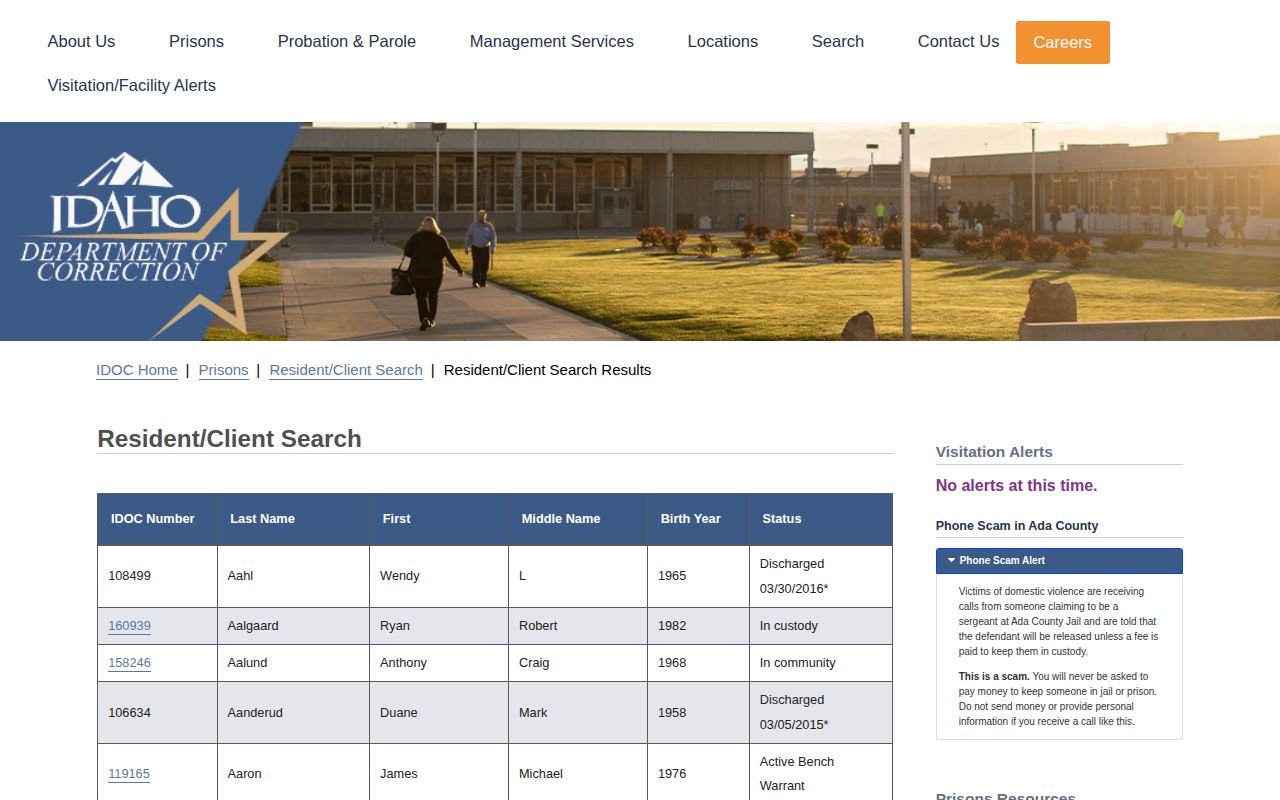
The result status is a routing clue. The detail supplies sentence rows such as Released to Supervision, Sentence Satisfaction Date, Parole Eligibility Date, and supervising district. IDOC says information updates daily and can change quickly, so District 3 or an IDOC GovQA record is the stronger confirmation when timing matters.
| Search item | How to use it |
|---|---|
| IDOC number | Best exact key when known |
| Name | Try spelling variants and compare middle name |
| Birth year | Helps separate similar names, but is not identity proof |
| Status | Distinguishes discharged, community, custody, and warrant routes |
No Canyon Recent-Release Feed
Canyon County publishes no verified 24-hour or 72-hour release list. Current Arrests contains a booking photo, name, County ID, arrest time, agency, charges, and VINE link, but it has no release date, reason, bond outcome, or current/released flag. The live roster has no released tab or archive. The county also publishes no retention or refresh promise for either tool, and no official Sheriff mobile app offering release lists or mugshots was verified. Do not relabel an arrest feed as a release list.
Roster Absence Can Mean Transfer
Canyon’s overcrowding makes a blank roster result unusually ambiguous. The county reports housing people in Valley, Adams, Washington, Payette, Owyhee, and Elmore County facilities. A person can leave the Caldwell building without leaving legal custody. Conversely, SILD, ICS, and Pretrial Release participants may appear outside the walls while still subject to a custodial or court-managed placement. The release form’s receiving-authority field resolves both problems more reliably than location alone.
Verify Canyon Post-Release Supervision
Parole is conditional community release from an IDOC prison sentence. Probation is a court-ordered community sentence and may occur without prison. IDOC supervises felony parole and probation through District 3 at 3110 East Cleveland Boulevard, Building D, Caldwell, 208-454-7601. Canyon Misdemeanor Probation is separate at 1102 E. Chicago Street, 208-454-7260. An IDOC detail marked “In community” should be read with its Parole or Probation row and Released to Supervision date. The Post-Release Supervision page explains Commission decisions, District 3 records, and warrant checks.
VINE, Federal, and ICE Checks
Idaho VINE accepts person searches and release-alert registration online or at 866-984-6343. County jail feeds have historically transferred frequently, but an alert is not an official release record and a “release” can precede another authority’s pickup. Use the VINE Inmate Check for a one-person search and confirm urgent results with the agency.
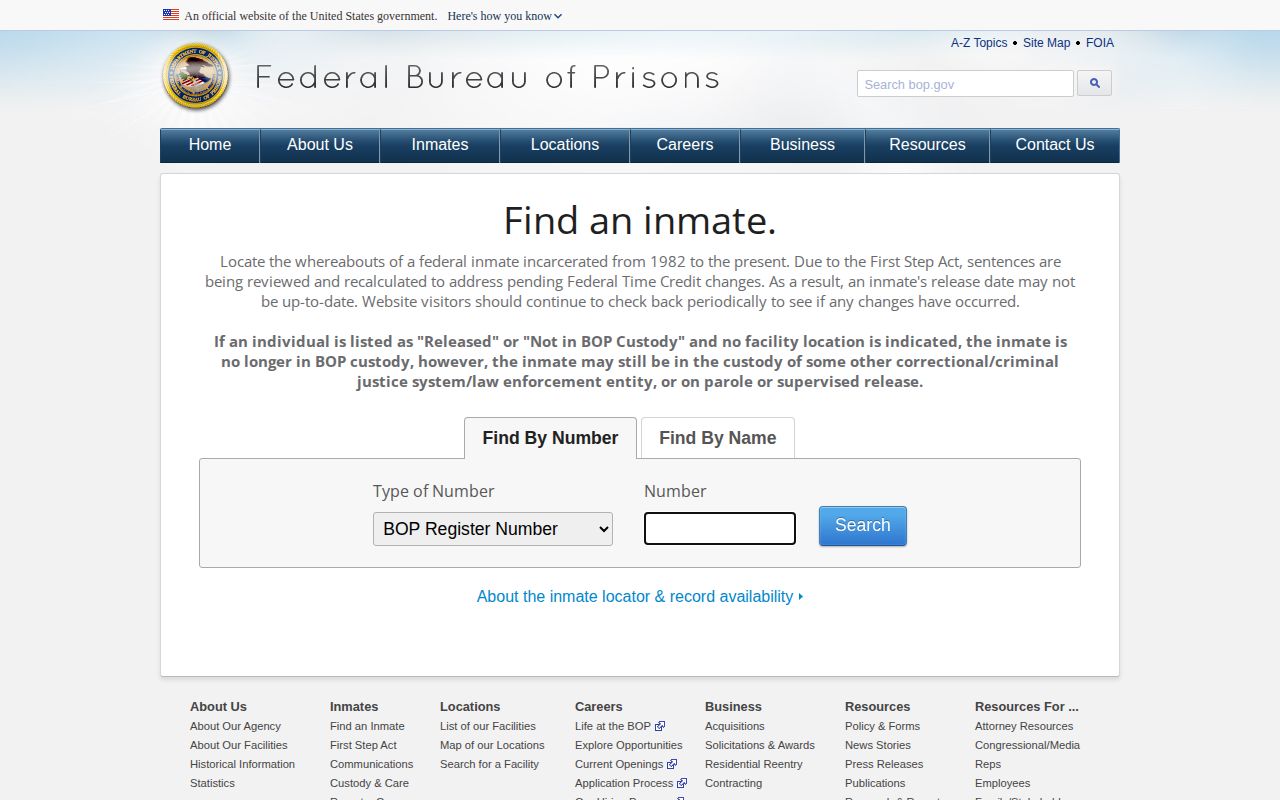
The BOP inmate locator covers federal inmates released after 1982 and can show a past or projected release date. A past BOP date does not rule out state, local, immigration custody, or federal supervision.
ICE ODLS can show current ICE custody or a release within the last 60 days, with limits for minors, protected records, and delayed data. Search by nine-digit A-number and country of birth or by full name, date of birth, and country. A shorter A-number needs leading zeros. A local release followed by an ICE transfer is not a community release.
Match the Record to Custody
| System | What a match means | Main limit |
|---|---|---|
| Canyon roster | Present in the current local system | No release field; special programs complicate location |
| Sheriff release form | Local custody-end transaction and receiving authority | Must be requested |
| IDOC search | State custody, community supervision, discharge, or warrant status | Does not cover routine county release |
| iCourt | Case orders, bond, judgment, and disposition | Does not supply actual jail exit time |
| BOP locator | Federal custody record and release date | Not local, state, ICE, or supervision proof |
| ICE ODLS | Current custody or some releases within 60 days | Protected people, minors, and older releases may not appear |
Avoid a False Identity Match
Names alone are not enough. Compare middle name, suffix, birth year, County ID, IDOC number, arrest date, case number, and agency. A common name can produce unrelated jail, court, and state records. The Idaho Sex Offender Registry applies only when a statutory registration duty exists and warns that name and date of birth are not positive identification; fingerprint comparison is definitive. Registry presence documents a continuing registration record, not the date or reason for release.
Release Forms, Property, and Commissary
Local release documentation extends beyond the roster. Idaho Jail Standards call for the signed release form and a signed property receipt, creating separate evidence of the custody event and returned belongings. Canyon County adds a specific commissary issue: when release occurs before commissary credit can be delivered, the credit becomes a prepaid card available for pickup at visitation. A person checking an incomplete property return should use the detention center’s process instead of assuming a balance disappeared. These operational records can corroborate timing, but the release form remains the source for the legal authority and receiving agency.
Outside Jail Is Not Always Discharged
Canyon operates SILD, ICS, and Pretrial Release as distinct alternatives. Pretrial contacts can occur by telephone, in an office, or at a residence, and noncompliance can return a participant to custody. SILD is a sentence alternative with locally published monthly, rescheduling, and no-show fees; failure can lead to an affidavit and arrest warrant. These arrangements explain why someone may be seen in the community while the roster still carries a status. Confirm final completion through the court disposition and Sheriff documentation, not observation.
Jail Statistics Do Not Name Releases
The county’s Jail Statistics application gives population, classification, facility utilization, out-of-county housing, and historical charts. Canyon says it updates around 5:15 a.m. and has data beginning November 1, 2018. That makes it useful for understanding crowding and transfer risk. It contains no names or release counts, however, and cannot be used as a recent-release feed or to decide whether a particular person left custody.
One Search Covers an Evolving Campus
The local Sheriff campus layers facilities from different eras: the Annex opened in 1948, the Haile center in 1993, and tent Pod 5 in 2006. Temporary Pod 6 women’s units later ended, while the county explored a permanent Pond Lane facility. Those names describe buildings and planning history, not separate custodians. Current Haile, Annex, Work Center, and Pod 5 records all route through the same Sheriff roster, records unit, VINE participation, and release process. Obsolete Pod 6 references should not be turned into a current inmate search.
Nampa Reentry Is Still IDOC Placement
Nampa Community Reentry Center creates a local transition route that can look like community release before it legally occurs. Residents are nearing parole or discharge and may participate in reentry activity, but they remain in an IDOC residential correctional placement. Confirm the actual change through the IDOC detail: In community with a Parole row and Released to Supervision documents a supervised transition, while Discharged marks the end of IDOC jurisdiction. District 3 publishes reentry tools, including purpose-neutral transportation and service navigation, but those resources do not change custody status.
Canyon County Custody Locations
Each facility page follows the correct custodian rather than assuming every building has a separate search. The Sheriff components share the Canyon roster, VINE feed, status line, and release-record process. Juvenile information follows restricted center and court channels. Nampa Community Reentry Center residents remain in IDOC placement until the state record documents transition.
- Dale G. Haile Detention Center / Canyon County Jail, the primary adult intake and release point.
- Canyon County Jail Annex, a connected 34-bed historic component.
- Work Center / Pod 4 Unit N, 40 work-release beds where daytime absence is not discharge.
- Pod 5 Tent Facility, 122-bed minimum-security housing using the same Sheriff release route.
- Southwest Idaho Juvenile Detention Center, a 90-bed regional facility with restricted youth records.
- Nampa Community Reentry Center, an IDOC residential reentry placement verified through state records.