
Where Nampa CRC Releases Go
Nampa Community Reentry Center is an IDOC placement. Departure may be release to parole supervision, another IDOC placement, or eventual discharge after the sentence is satisfied. “In community” means the person is outside a state prison under supervision; open the detail to see whether the row says Parole or Probation and to read Released to Supervision. “Discharged [date]” is stronger evidence that IDOC jurisdiction ended. Neither status is supplied by the Canyon jail roster.
The decisive local document is the jail release form or log. Idaho Jail Standards require it to identify release date and time, authority for release, receiving authority when one exists, and the releasing deputy. Those fields separate a community departure from a handoff. A court order can explain legal authority, but it does not supply the exact moment Canyon County relinquished custody. If the form names a receiving agency, continue the check in that agency's system.
Confirm a Nampa CRC Release
Use the statewide IDOC Resident/Client Search. Search by last name and optional first name or by IDOC number, then compare IDOC number, middle name, and birth year. The result labels Discharged, In community, In custody, and Active Bench Warrant describe materially different states.
- Enter at least two last-name characters or three IDOC-number digits and choose the correctly matched result.
- Open the detail instead of stopping at “In community.” Read the Parole or Probation row, Released to Supervision, Sentence Satisfaction Date, district, and officer fields.
- Call NCRC at 208-465-8490 or the named supervision district when the daily public record may lag.
- Use IDOC GovQA for a release-to-supervision record, discharge certificate, sentence calculation, or final-status record.
- Use VINE for a timely event alert, but reconcile it with IDOC because a movement alert is not a certified discharge record.
The site's Canyon County released-inmate search and records guide explains this full custody-classification path. A no-match should never be converted into a factual claim that the person is free.
Nampa CRC Records and Contact
NCRC can address facility information, while IDOC owns the state custody record. Canyon County Sheriff Records does not issue the state release-to-supervision or discharge record for an NCRC resident.
1640 11th Avenue North
Nampa, ID
208-465-8490
For documents, submit an IDOC GovQA request by full name, date of birth, IDOC number, and a narrow date range. Ask for the release-to-supervision entry, discharge certificate or Gold Seal, sentence calculation, and final-status record. The supervising district shown on the IDOC detail is the best follow-up for an In community case.
About Nampa CRC
NCRC is an IDOC residential correctional and reentry facility at 1640 11th Avenue North in Nampa. Residents are approaching parole or release but remain in state placement until the IDOC record reflects the transition. The facility's location in Canyon County does not place residents in Sheriff custody.
- Operator
- Idaho Department of Correction
- Role
- Residential correctional and reentry placement
- Public lookup
- IDOC Resident/Client Search
- Transition proof
- IDOC status detail and requested state movement or discharge record
A CRC resident can be physically in Canyon County while remaining absent from the county jail roster. Keep state and county identifiers separate.
Nampa CRC Release Record Fields
A useful request asks for fields that answer who, when, why, and where. Protected medical or safety details may be redacted from a public copy, but the custody-chain fields remain the key to understanding the event.
| Field | What it establishes |
|---|---|
| Overall status | In custody, In community, Discharged, or Active Bench Warrant |
| Released to Supervision | Start of the displayed supervision period |
| Parole or Probation | The kind of community supervision |
| Sentence Satisfaction Date | Calculated full-term endpoint |
| District and officer | Current supervision contact when displayed |
A parole transition is conditional community supervision, not full discharge. A probation row does not prove a prior prison release.
NCRC Is State Custody
The local placement is categorically separate from the Sheriff campus. Haile, Annex, Unit N, and Pod 5 share one county system; NCRC belongs to IDOC. That line determines which locator, identifier, records office, and release vocabulary applies.
The IDOC community reentry centers page documents NCRC's role.
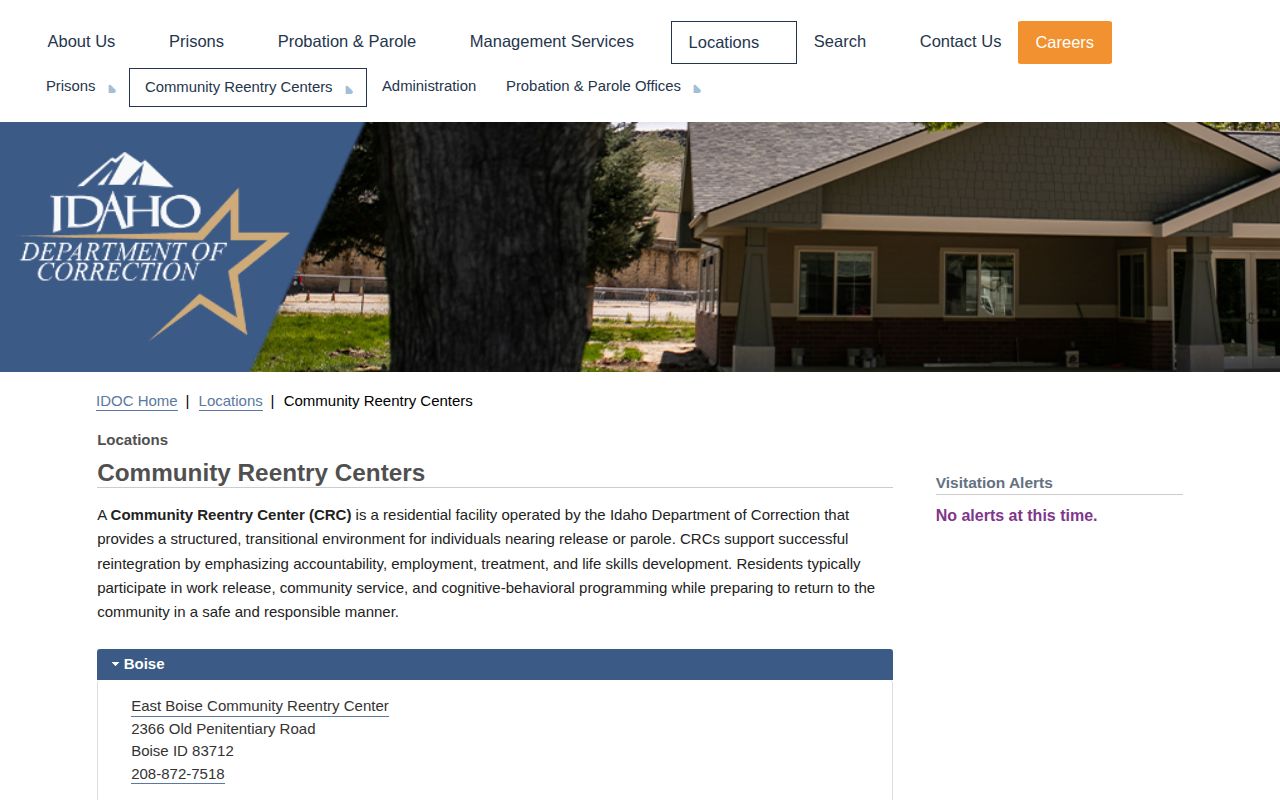
The facility image supports the state-placement distinction, not a person-specific status conclusion.
NCRC Record Reconciliation
Compare the public IDOC status with the underlying state record and the supervising office. A court case may explain the sentence, but the IDOC movement record confirms the state transition. VINE can alert on an event but may lag its source.
Do not apply Canyon jail property or commissary procedures to NCRC. Questions about state-resident property or transition processing belong with NCRC or IDOC.
Note: Live tools, contacts, and facility plans can change; confirm important details with the originating Canyon County office.
NCRC State Transition Fields
IDOC uses several date labels that should not be merged. Released to Supervision marks the most recent start of a supervision period. Sentence Satisfaction Date is the calculated full-term endpoint. Parole Eligibility Date is the earliest consideration point, and a Tentative Parole Date remains conditional until requirements are met. Only the actual status and movement record show what occurred.
An In community result can describe either parole or probation. Open the conviction or supervision detail and read the row label, district, officer, and phone. Probation does not necessarily follow a prison release. Parole is conditional release from the prison portion of an IDOC sentence. Discharged indicates state jurisdiction ended on the displayed date.
IDOC says the public search updates daily, so a facility move or transition can precede the web display. Contact NCRC or the supervising district for current information and use GovQA for documentary proof. An old satisfied conviction row may no longer display even when a discharged name and date remain searchable.
The official NCRC manifest image links to IDOC's community reentry centers page and confirms the state facility category. It does not establish any resident's status.
Match an NCRC Resident
IDOC search results show IDOC number, last, first, and middle name, birth year, and status. Compare several identifiers before opening a record. IDOC accepts at least two characters of a last name or three digits of an IDOC number, but a broad partial search can return several people. A name alone is not enough for a reliable identity match.
Once the correct detail is open, read each conviction and supervision row in context. Sentencing county can be Canyon County while the present supervising office is elsewhere. An old satisfied conviction row may disappear from detail, while the discharged result retains a name and date. Save the source date when recording what the live portal displayed.
An Active Bench Warrant label is neither discharge nor ordinary community release. In custody means the person remains in IDOC custody, even if the exact placement changes. In community requires opening the detail to distinguish parole from probation. These labels prevent a CRC departure from being reduced to a vague “released” claim.
After an NCRC Transition
When the detail shows parole and Released to Supervision, the person has moved from the prison portion of the sentence into conditional community supervision. The district, officer, and phone fields can provide the current route. A Sentence Satisfaction Date is a calculated endpoint and should not be substituted for the physical transition date.
A later Discharged status indicates IDOC jurisdiction ended on the displayed date. Formal completed-sentence evidence can include a Gold Seal discharge notification. The Idaho Commission of Pardons and Parole says that notice passes through the last supervision district and can take up to a month, so the document may follow the public status change.
IDOC District 3 covers Canyon and nearby southwest Idaho counties, but sentencing location does not guarantee the case remains there. Use the office displayed on the current detail. If the public record and a recent event disagree, ask that office or IDOC Records to reconcile them.
NCRC and Other Custody Systems
A Canyon County booking, federal case, or immigration matter may exist alongside an IDOC record, but each system proves only its own custody. BOP release does not prove IDOC discharge. An ICE result does not replace the state transition record. A county roster absence says nothing reliable about an NCRC resident.
Build the proof chain from IDOC status, the person detail, the supervising office, and the requested movement or discharge record. Add a court judgment only for legal context. That scoped approach produces a clearer answer than searching every inmate portal for the same name.